First implemented in January 2011, the Food Safety Modernization Act (FSMA) encompasses a host of food safety regulations. Many of these rules impact the operations of ABCO drivers and shippers transporting food deliveries, especially refrigerated freight shipments. Here’s a quick snapshot of five FSMA fast facts to inform drivers about these important transportation practices when carrying both human and animal food.
What did the Food Safety Modernization Act do?
The Food Safety Modernization Act (FSMA) addresses the safety of human and animal food during transport. This act affects all shippers, carriers and receivers contracted to transport food by motor vehicles and rail transport.
The FSMA’s goal is to shift the focus of food safety in the United States from one of response to one of prevention.
Why Exactly does “Food Safety” Mean?
According to the Unites States Department of Agriculture (USDA), food safety “refers to the conditions and practices that preserve the quality of food to prevent contamination and foodborne illnesses.”
The Food Safety Modernization Act upholds this standard by protecting food shipments from the risk of foodborne disease and taking a preventative-based approach.
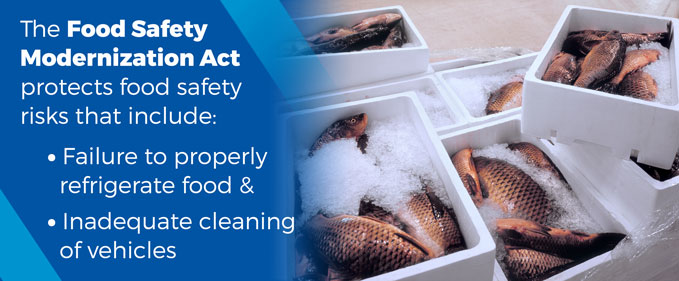
The rule is intended to mitigate food safety risks that include failure to properly refrigerate food as well as inadequate cleaning of vehicles.
What Preventative Controls Does the FSMA Enforce?
The following controls are in place and enforced by the FSMA:
- Vehicles and transportation equipment are designed to ensure no contamination of food during transport.
- Transportation operations, such as temperature controls for refrigerated freight, must ensure there is no food contamination.
- Procedures and effective communication between the shipper, carrier and receiver are vital to keeping food shipments safe.
- Effective sanitary procedures and protocols must take place.
- Proper maintenance and record keeping between shippers and carriers regarding food shipments are necessary.
- Waivers, when applicable, if any of the above requirements are not needed to provide safe food transport.
What are the Temperature Requirements for Refrigerated Freight?
In 2017, the FMSA introduced a new rule pertaining to the Sanitary Transportation of Human and Animal Food (ST2017). This standard includes guidance on temperature control for vehicles using refrigerated trailers to preserve food safety.
Notably, ST2017 does not mandate temperature minimums/maximums for specific foodstuffs, rather “vehicles and transportation equipment used in the transportation of food requiring temperature control for safety must be designed, maintained, and equipped as necessary to provide adequate temperature control to prevent the food from becoming unsafe during transportation.” Essentially, the responsibility falls to the shipping provider to maintain “adequate” temperature control and ensure food does not meet the criteria for spoilage.
ABCO provides complete temperature-controlled profiles for your shipments to meet this FSMA requirement. ABCO offers:
- Defined operational procedures
- Food-Grade equipment
- Documented and reviewable process
- Thermo King for pre-cooling and monitoring
What are the FSMA Training Requirements?
The U.S. Food and Drug Administration (FDA) recognizes the importance of FSMA training to securing a contaminant-free food supply chain. As such, the FDA recognizes the importance of several public-private relationships to unite federal and state industries, as well as industry producers, academic institutions and transportation providers with a common understanding of FSMA regulations. Many organizations fall under the umbrella of what is called the FSMA Alliance, a group that establishes training curricula for domestic and foreign food transportation providers. domestic and foreign food transportation providers.
At ABCO, all personnel are given both initial training and continual training. Safety leadership also oversees all FSMA requirements to ensure company drivers and independent contractors adhere to proper regulations from the start of every pickup to the end of each delivery.
Drive for ABCO
ABCO Transportation has career openings for company drivers and independent contractors. Applicants must be 21 years or older and have a current CDL Class A License. Preference will be given to individuals who also have at least one year of over-the-road (OTR) experience. Our employees enjoy competitive pay, full medical benefits, 401(k) with match, paid vacation and access to three exclusive company resorts. Apply today and start your career with ABCO Transportation!